
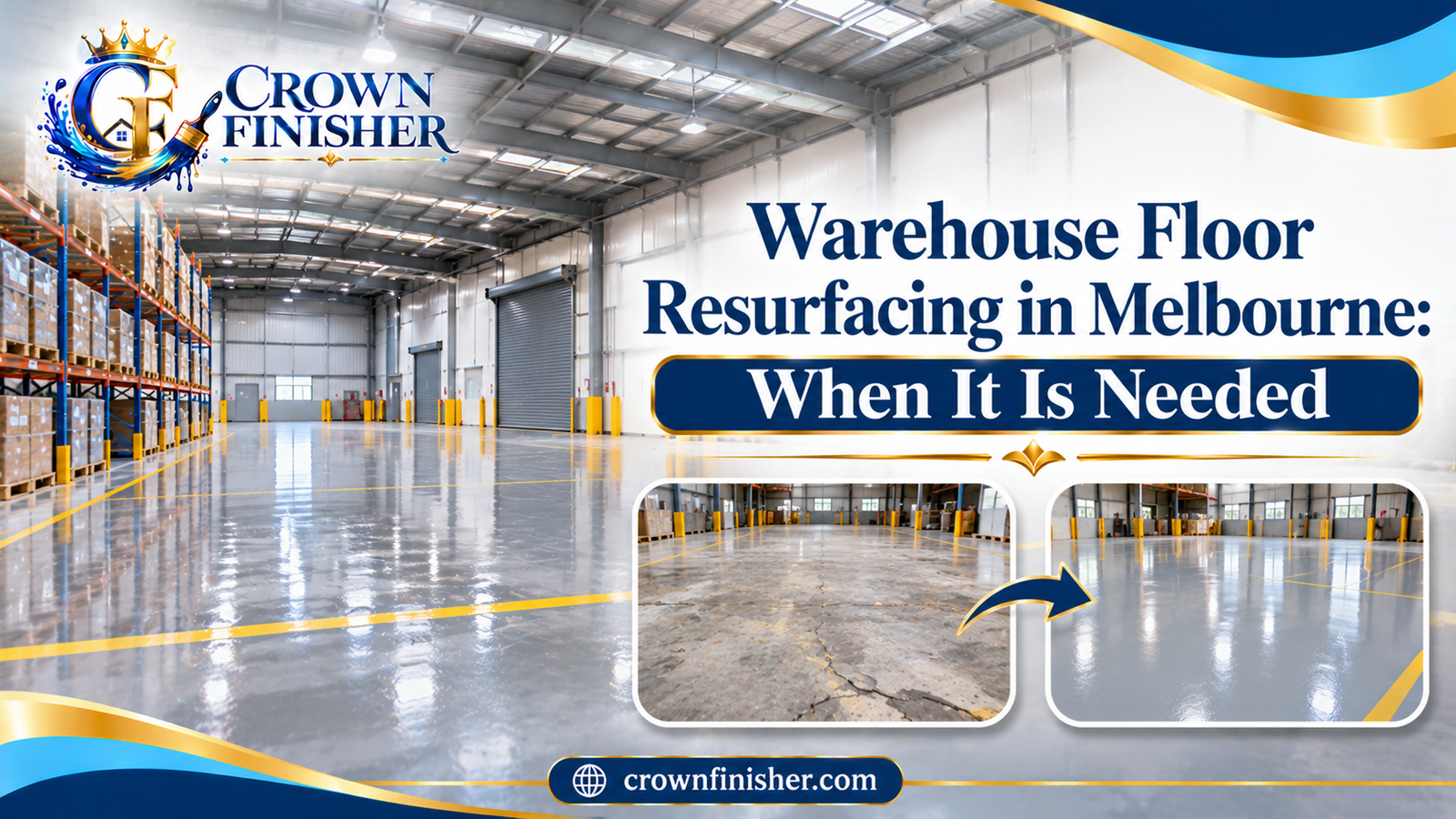
The floor is the most heavily used surface in any warehouse. Every pallet, forklift and delivery passes over it, and every crack, pothole and broken joint slows work down, damages equipment and creates trip hazards.
Warehouse flooring does not last forever, but most worn floors can be brought back without replacing the slab. This guide explains what warehouse floors are made of, the signs that resurfacing is needed, the difference between repair, restoration and resurfacing, and how the process works for businesses in Melbourne.
Table of contents
What are most warehouse floors made of?
Most warehouse floors are reinforced concrete slabs. The concrete is usually trowelled smooth when poured and may be left bare, sealed, polished, or finished with an epoxy or polyurethane coating. The slab is cut or formed into panels with joints that allow the concrete to move slightly as it shrinks and changes temperature.
Concrete is strong, but its surface is softer than many people expect. Over years of forklift wear, dragging pallets and spills, that surface breaks down, which is why warehouse flooring eventually needs attention.
Signs your warehouse floor needs resurfacing
- Cracked concrete spreading across panels or around columns and racking.
- Damaged joints with chipped edges that forklift wheels bump over.
- Dusting, where the surface keeps producing fine concrete dust that settles on stock and equipment.
- Forklift wear lanes, ruts and worn turning areas.
- Potholes and spalling, where pieces of the surface have broken away.
- Worn or peeling coatings and faded line marking.
- Oil and chemical stains that have soaked deep into the concrete.
- Slippery or uneven areas that create safety concerns.
Wide cracks that keep growing, panels that rock or sink, or cracks with one side higher than the other can point to structural or ground movement. These should be assessed by a structural engineer before any resurfacing work.
Repair, restore or resurface?
| Approach | When it suits | What it involves |
|---|---|---|
| Warehouse floor repair | Isolated cracks, broken joints and small potholes | Targeted crack filling, joint repair and patching in the problem areas |
| Warehouse floor restoration | A sound slab with a worn, dusty or stained surface | Grinding, repairs, then sealing or a new coating across the floor |
| Full resurfacing | Widespread wear, rough or uneven surfaces | Grinding, repairs and a resurfacer or thick coating system over the whole area |
| Slab replacement | Structural failure or severe ground movement | Removing and repouring sections of concrete, usually by a concrete contractor |
Warehouse floor resurfacing methods
Grinding and sealing
Best for: worn but level floorsDiamond grinding removes the weak, dusty top layer and old coatings, then a sealer locks in the surface to reduce dusting and staining.
Cementitious resurfacer
Best for: rough or pitted concreteA thin, high strength resurfacer is applied over prepared concrete to create a fresh, level surface that can then be sealed or coated.
Epoxy topcoat systems
Best for: durability and chemical resistanceAn epoxy topcoat or high build system seals the restored floor, handles forklift traffic and makes cleaning easy. Anti slip and line marking can be added.
Joint and crack repair
Best for: damaged joints and cracksBroken joint edges are rebuilt and cracks are filled with suitable repair materials so wheels roll smoothly and damage stops spreading.
The warehouse floor resurfacing process
Site assessment
The floor is inspected for cracks, joint damage, contamination, moisture and existing coatings, and traffic patterns are noted so the right system is chosen.
Plan around operations
Work is staged by zone, after hours or over weekends so stock, racking and forklift movements can continue as much as possible.
Grinding
Diamond grinding or shot blasting removes weak concrete, old coatings and contamination, with dust extraction to keep the site clean.
Floor repair
Cracks, potholes and damaged joints are repaired and levelled so the new surface is smooth and continuous.
Resurfacer or coating
A resurfacer, sealer or epoxy topcoat system is applied to suit the traffic, chemicals and finish required.
Line marking and cure
Walkways, forklift routes and storage zones are marked, then the floor is left to cure before returning to full use.
Fixing damaged joints early is one of the cheapest ways to protect a warehouse floor. Once forklift wheels start hitting a chipped joint, the damage spreads quickly along the edge and into the surrounding concrete.
Joints and cracked concrete
Joints are the weakest point of most warehouse floors. Hard forklift wheels hit the joint edges thousands of times, which chips the concrete and widens the gap. Repairing the edges and filling the joints with a suitable flexible or semi rigid filler supports the edges and gives wheels a smoother path.
Fine shrinkage cracks are common in concrete and can usually be filled and sealed during resurfacing. Larger, moving cracks need to be assessed first so the repair suits the cause, rather than simply being covered over.
What affects the cost of warehouse floor resurfacing?
- Floor area and how it is split into zones.
- Condition, including the number of cracks, potholes and damaged joints.
- Existing coatings that need grinding off.
- The system chosen, from grinding and sealing to a full resurfacer and epoxy topcoat.
- Access and timing, such as after hours or weekend work around operations.
- Extras such as anti slip finishes and line marking.
An inspection and a written, itemised quote is the only reliable way to know the exact cost for your floor.
Is epoxy cheaper than concrete?
Epoxy does not replace concrete; it protects it. Restoring and coating an existing slab is usually much less costly and disruptive than breaking out and repouring concrete. For a full comparison of epoxy systems, see our guide to epoxy floor coating for warehouses.
Warehouse flooring in Melbourne
Crown Finisher Painters has more than 10 years of experience and over 600 completed projects across Melbourne. Our epoxy floor coatings team handles warehouse floor restoration, grinding, crack and joint repairs, epoxy topcoats and line marking for factory flooring in Melbourne.
We also provide warehouse painting, industrial painting and commercial maintenance painting, so walls, steel and floors can be planned together.
Frequently asked questions
What are most warehouse floors made of?
Most warehouse floors are reinforced concrete slabs, trowelled smooth when poured and divided into panels by joints. The concrete may be left bare, sealed, polished, or finished with an epoxy or polyurethane coating for extra durability and easier cleaning.
How much does it cost to resurface concrete in Melbourne?
The cost depends on the floor area, its condition, the number of cracks and damaged joints, any existing coatings to remove, the resurfacing system chosen, access and timing, and extras such as anti slip finishes and line marking. Crown Finisher provides a free, written quote after inspecting the floor.
Is epoxy cheaper than concrete?
Epoxy does not replace concrete; it protects it. Restoring and coating an existing slab is usually much less costly and disruptive than breaking out and repouring concrete, and the coating helps the slab last longer.
What is warehouse floor restoration?
Warehouse floor restoration brings a sound but worn concrete floor back to good condition. It usually includes grinding off the damaged surface and old coatings, repairing cracks and joints, then sealing the floor or applying a new coating such as an epoxy topcoat.
What does warehouse floor repair involve?
Warehouse floor repair targets specific problems, such as filling cracks, rebuilding chipped joint edges, patching potholes and spalled areas, and repairing damaged coatings. It is often done before a wider restoration or as ongoing maintenance to stop damage spreading.
Final thoughts
Cracked concrete, broken joints, dusting and forklift wear are all signs that warehouse flooring needs attention. Catching problems early with targeted repairs, and restoring or resurfacing the floor before damage spreads, keeps the site safe and avoids the cost and disruption of replacing the slab.
When your warehouse floor needs work, contact Crown Finisher Painters for a site inspection and a free, written quote.